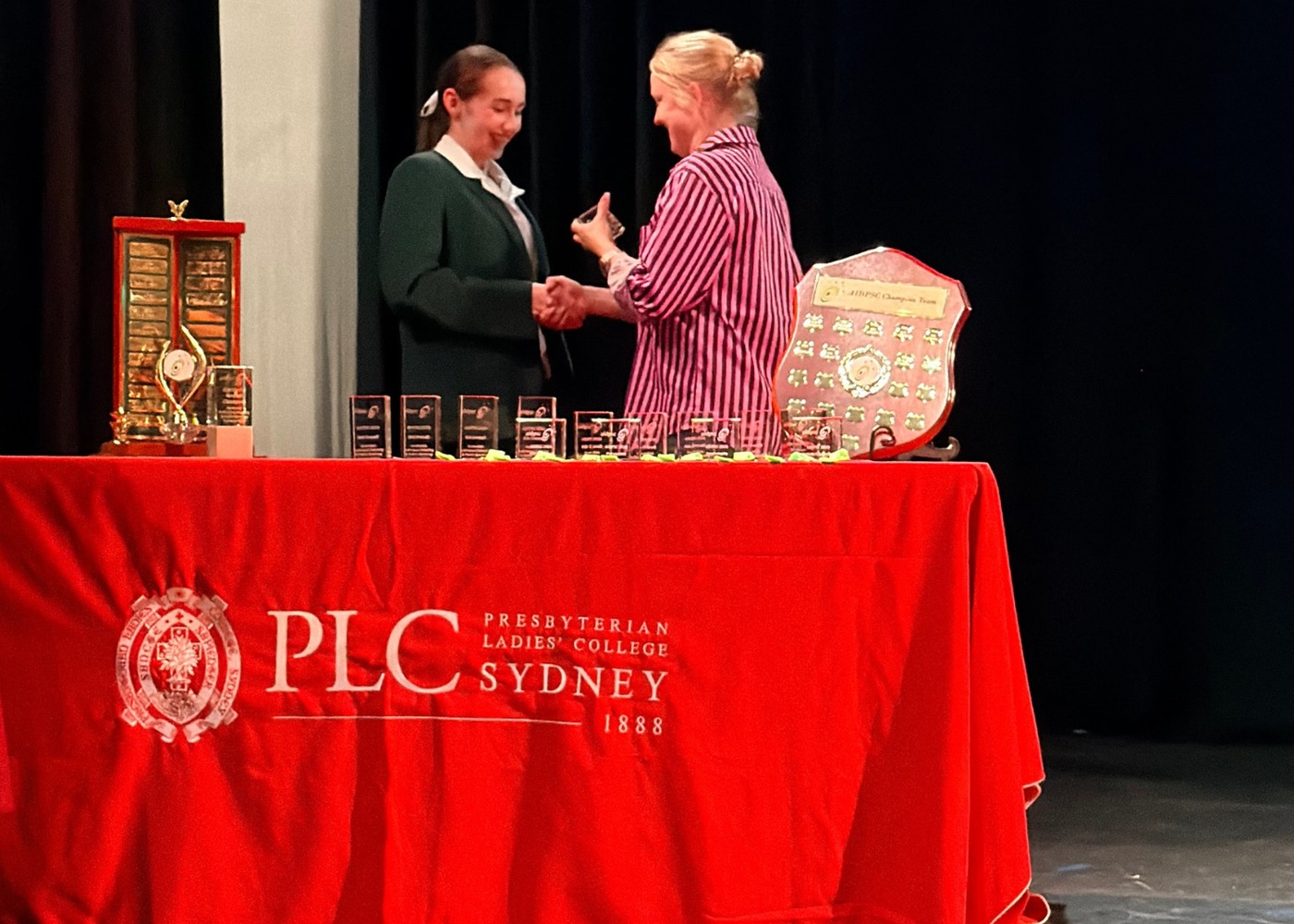
ON THE NATIONAL STAGE: PODIUMS, CAPS AND HISTORY MADE
20 Oct 2026




| Subject | Units - Year 11 | Units - Year 12 |
|---|---|---|
| English Literature (9695) | 3 units | 3 units |
| Pure Mathematics (9709) | 3 units | 4 units |
| Chemistry (9701) | 2 units | 2 units |
| Physics (9702) | 2 units | 2 units |
| Biology (9700) | 2 units | 2 units |
| Economics (9708) | 2 units | 2 units |
| History (9489) | 2 units | 3 units |
| Sociology (9699) | 2 units | 2 units |
| Business Studies (9609) | 2 units | 2 units |
| Art and Design (9479) | 2 units | 2 units |
| Work Studies | 1/2 units | |
| Sport, Lifestyle & Recreation (SLR) | 1/2 units |
To meet NESA requirements, Year 11 students must complete the equivalent of 12 units across at least four Cambridge subjects, including English.
Students must study:
Depending on their subject selections, students may need to complete one or more Course Endorsed Courses (CEC) to reach the required 12 units.
| Subject | Units |
|---|---|
| English Literature | 3 |
| Pure Mathematics | 3 |
| Chemistry | 2 |
| Biology | 2 |
| Work Studies | 2 |
| Total | 12 |
To meet NESA requirements, Year 12 students must complete the equivalent of 10 units.
Students must study:
One English subject
Plus three additional Cambridge subjects
Depending on their subject selections, students may be able to reduce or discontinue some CEC courses while maintaining the required 10 units.
| Subject | Units |
|---|---|
| English Literature | 3 |
| Chemistry | 2 |
| Biology | 2 |
| Economics | 2 |
| Sport, Lifestyle and Recreation (SLR) | 1 |
| Total | 10 |
Subject selections may change between Years 11 and 12, provided students continue to meet NESA unit requirements.
Students may supplement their Cambridge studies with the following non-examinable Course Endorsed Courses:
These courses can be used to meet minimum NESA unit requirements.
Although there are no formal examinations, students are required to demonstrate achievement of syllabus outcomes throughout the course.
Work Studies helps students bridge the gap between school and the workplace. Through practical experiences, career exploration, workplace visits, university experiences and employability skill development, students gain valuable insights into future pathways and career opportunities.
SLR provides students with opportunities to develop knowledge and skills related to physical activity, fitness, wellbeing, leadership and recreation. The course supports students in building lifelong habits that contribute to healthy and active lifestyles.
The course consists of three practical components completed across Years 11 and 12.
In Year 11, students study:
In Year 12, students study:
The course is broadly comparable to HSC Visual Arts but has no written examination and focuses on practical and conceptual development.
There are no formal prerequisites for this course.
The course consists of five examination papers completed across Years 11 and 12.
In Year 11, students study:
Two theory papers and one practical paper covering cell biology, biological molecules, genetics, transport systems and ecology.
In Year 12, students study:
Two theory papers covering physiology, energy transfer, homeostasis, evolution and biotechnology.
The course is more rigorous than HSC Biology but includes significant overlap in content and develops strong scientific analysis and practical skills.
Students are required to have completed IGCSE Biology before commencing the course.
The course consists of written examinations completed across Years 11 and 12.
In Year 11, students study:
In Year 12, students study:
The course develops students' understanding of how organisations operate and make decisions in competitive local and global environments, while building strong analytical, problem-solving and decision-making skills.
There are no formal prerequisites for this course.
The course consists of examination papers completed across Years 11 and 12 including both theory and practical components.
In Year 11, students study:
In Year 12, students study:
The course is more rigorous than HSC Chemistry but has substantial overlap in content and develops strong analytical and problem-solving skills.
Students are encouraged to have completed IGCSE Chemistry before commencing the course.
The course consists of written examinations completed across Years 11 and 12.
In Year 11, students study:
In Year 12, students study:
The course is slightly more challenging than HSC Economics but has strong overlap in content and develops analytical and evaluative skills.
There are no formal prerequisites for this course.
The course consists of written examinations completed across Years 11 and 12.
In Year 11, students study:
Language use in social, cultural and professional contexts, including identity, power and communication.
In Year 12, students study:
Language change, language acquisition and advanced text analysis.
The course is more linguistics-focused than HSC English Standard or Advanced and develops strong analytical and communication skills.
There are no formal prerequisites for this course.
The course consists of written examinations and coursework completed across Years 11 and 12.
In Year 11, students study:
In Year 12, students study:
The course is broadly comparable to HSC English Extension and develops advanced analytical and critical writing skills.
There are no formal prerequisites for this course.
The course consists of written examinations completed across Years 11 and 12.
In Year 11, students study:
In Year 12, students study:
The course is broadly comparable to HSC History Extension in terms of academic rigour and critical thinking.
Students are encouraged to have completed IGCSE History or Stage 5 History.
The course consists of five examination papers completed across Years 11 and 12.
In Year 11, students study:
In Year 12, students study:
The course is more rigorous than HSC Physics but has significant overlap in core content and develops strong analytical and problem-solving skills.
Students are encouraged to have completed IGCSE Physics before commencing the course.
The course consists of four examination papers completed across Years 11 and 12.
In Year 11, students study:
In Year 12, students study:
The course is broadly comparable to HSC Mathematics Extension 1 and develops advanced mathematical reasoning, modelling and problem-solving skills.
While there are no formal prerequisites, students should demonstrate strong mathematical ability and are recommended to achieve a high standard in Year 10 Mathematics.
The course consists of four examination papers completed across Years 11 and 12.
In Year 11, students study:
Socialisation, identity, research methods and the family.
In Year 12, students study:
Education, globalisation, media and religion.
The course does not have a direct equivalent within the HSC curriculum and develops strong analytical and research skills in understanding society.
There are no formal prerequisites for this course.
Yes. Subject selections may change, provided students continue to meet NESA minimum unit requirements.
Yes. English is a compulsory component of the Cambridge pathway at PLC Sydney.
No. CEC courses do not have formal examinations but students must demonstrate achievement of syllabus outcomes.
Yes. Cambridge International A Levels are widely recognised by universities throughout Australia and around the world.
Yes. PLC Sydney intends to expand the range of Cambridge subject offerings over time.
Students undertaking Cambridge courses are charged a flat examination fee of $275 per subject, per year, in addition to standard school fees.
For example:
There are no examination fees for Course Endorsed Courses (CEC).
If Cambridge International schedules an examination during a public holiday or school holiday period, an additional fee of $250 per examination may apply.
Please note that PLC Sydney has no control over the scheduling of Cambridge examinations.

